skip to main |
skip to sidebar
 This is my Texas Yellow Mud Turtle. It is about four inches long. It is a pretty neat little turtle. I have it in the ten gallon tank which has tropical fish also. The small mud turtles do not seem
  to be very fast when it comes to hunting fish, so the tropical fish seem to mostly survive in the tank. I have a variety of fish. Glass shrimp, neons, mollies, guppies, zebra danios, a red-tail barb, and I had a catfish but it looks like it was eaten by the turtles.
 The Texas Mud Turtle has a sort of mustard color. It is named a Yellow Mud Turtle because the skin on its neck is sort of yellowish. It is different from the standard Mud Turtles that I have gotten in the past. It also seems to be more shy and thoughtful.
  That may sound silly, but this turtle will look around and turn her head at things. The little turtle seems to be thinking about what to do. Too bad turtles can't talk, it would be interesting to hear what it is thinking about.
 She has a very short tail, so she is a female turtle. My child has named all the turtles but I don't remember this one's name. This little turtle also seems to enjoy looking at its
  own reflection in the glass of the aquarium. When I see the turtle doing that, it reminds me of that song by Siouxie and the Banshees (Through the Looking Glass). The larger turtles in the other aquarium are used to looking through the glass. They can see me when I walk by, and they start sticking their heads out of the water and paddling when they want food. I guess it must be weird to be a turtle in an aquarium looking out at people walking by.
I was very fortunate to find a pet store that had a baby Mud Turtle in the summer of 2003. It was purely an accident. As often happens when you are not looking for something is when you find it. Mud and Musk Turtles are not kept at most pet stores because I believe that they are harder to care for and also less colorful. The brownish or black shells of the Mud and Musk Turtles probably make them less attractive than the colorful Sliders, Painted Turtles, and similar breeds. So I was knocked out when I saw this small rectangular light brown little turtle. I immediately called for a staff member to bag the turtle, as if there were suddenly going to be a rush of interested buyers. The little gal (very short tail) was kind of shy, always hiding under the various aquarium ornaments. But she thrived.
She gradually got bigger, and then we moved to a new home, and after the move the aquarium was set-up again. A few days later the little Mud Turtle was gone. I looked all over the aquarium and turned over the various bridges and artificial rock formations. No turtle. I thought maybe he had somehow climbed out. I searched around the house and under the furniture. No Turtle. After another day, I decided to take out every piece of aquarium furniture (ornaments, rocks, bridges) and check it. These plastic resin bridges and rock formations are hollow-molded so they are lighter and cheaper to produce. Most of them have holes in the bottom at their base. I pulled out each piece, let the water drip out, and then checked the hole in the base. When I got to the rock formation, it was too dark to see all the way in, but when I shook it there was something wedged in there. Sadly, it was not a rock. I could not shake it loose, so I got a screwdriver and pulled the plastic resin rocks apart, and in the top layer of plastic rock formation was the little mud turtle. She was dead. Finding an innocent creature dead like that is grim. Drowning inside the hollow of a plastic resin rock formation has to be harsh by any standard.
Apparently she tried to climb all the way up from the inside of the rock formation and she got wedged in. Why had she done this? I am guessing that the stress from the move made the normally shy mud turtle more anxious and nervous, and perhaps when she pushed the rock base up and found the dark hollow, she just wanted to crawl far away from the chaos in the newly set-up tank. Who knows? Anyhow, it was a hard lesson to learn, but I have pulled out anything that has a hollow base which any small turtle can possibly crawl into.
 Right now I have one small Mud Turtle, two Musk turtles, a red-eared slider, two yellow-bellies and a map turtle. I got the Mud turtle when she was just a few months old and about an inch long. Now she is about two inches long, and she is about two years old. The turtles are presently in a twenty gallon reptile aquarium (long tank) filled almost to the top with water. I have a Tetris 1 water filter. The turtles have a couple of areas where they can bask in the sun and/or lamplight. Even though lamp light is not the same as the sun, it seems to have a positive effect on the turtles' health.
The Red-Eared Slider, one of the Yellow-Bellies, and the Map turtles are about four inches long, and their shells are thick, hard, and wide. One of the Yellow Belly turtles, and the Mud and Musk Turtles seem to be growing at a slower pace. I feed the turtles a variety of foods like Reptomin, Tetramin, Goldfish Crumbles, moist Turtle Treats, and three other jars of hard Turtle food. The turtles are great eaters, and the little Mud Turtle and the two Musk Turtles always seem to be eating too, but they just seem to grow slower. Turtles get to know the people who are regularly feeding them, and they react when any of us walk by since we are the only ones who feed them. They get very excited and swim to the top, and look for food sticks. They like to be fed by hand.
This aquarium also has guppies, Neons, Tetras, Mollies and I just added some glass shrimp. Unfortunately, it seems like the turtles are snacking on the shrimp so there may not be too many of them left. Aquariums are a lot of fun to maintain once you get one set up and the water is settled and clear. An aquarium with turtles is even more interesting, as turtles have a lot more personality than fish! However, turtles demand more care than fish, and they are more difficult to keep healthy.
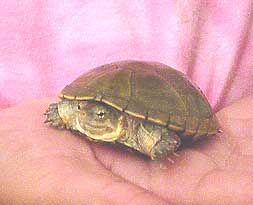 This is my Texas Yellow Mud Turtle. It is about four inches long. It is a pretty neat little turtle. I have it in the ten gallon tank which has tropical fish also. The small mud turtles do not seem
  to be very fast when it comes to hunting fish, so the tropical fish seem to mostly survive in the tank. I have a variety of fish. Glass shrimp, neons, mollies, guppies, zebra danios, a red-tail barb, and I had a catfish but it looks like it was eaten by the turtles.
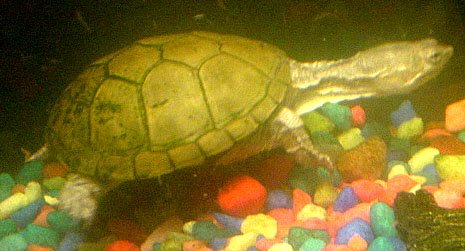 The Texas Mud Turtle has a sort of mustard color. It is named a Yellow Mud Turtle because the skin on its neck is sort of yellowish. It is different from the standard Mud Turtles that I have gotten in the past.
  That may sound silly, but this turtle will look around and turn her head at things. The little turtle seems to be thinking about what to do. Too bad turtles can't talk, it would be interesting to hear what it is thinking about.
 She has a very short tail, so she is a female turtle. My child has named all the turtles but I don't remember this one's name. This little turtle also seems to enjoy looking at its
  own reflection in the glass of the aquarium. When I see the turtle doing that, it reminds me of that song by Siouxie and the Banshees (Through the Looking Glass). The larger turtles in the other aquarium are used to looking through the glass. They can see me when I walk by, and they start sticking their heads out of the water and paddling when they want food. I guess it must be weird to be a turtle in an aquarium looking out at people walking by.


